
Core Insights
A supplement brand with $4M in annual revenue had a broad wellness audience purchasing protein, adaptogens, and metabolic support products. Customers were increasingly asking about weight loss support beyond supplements. The brand's product development team had been researching GLP-1 and peptide options for over six months.
The founder wanted to add clinical programs to the existing store without migrating platforms or disrupting the supplement business. Telehealth needed to operate as a parallel revenue channel, not a replacement.
The Challenge
The brand's technology stack was entirely built around Shopify and their existing supplement fulfillment partner. Adding a clinical program meant introducing a completely different operational layer for prescription management, provider review, and pharmacy fulfillment.
The founder's concern was not whether to launch — the commercial case was clear. It was how to launch without the clinical program becoming a distraction from the supplement business that was already working.
Step 1 — Parallel Channel Configuration
The telehealth storefront was configured as a standalone branded channel separate from the Shopify supplement store. Customers could access both from the brand's website without confusion between product types.
Step 2 — Program Selection and Intake Build
The brand launched with a GLP-1 weight loss program as the first clinical category. Intake forms were built and reviewed against the program's clinical requirements before launch. A peptide add-on program was staged for the second quarter.
Step 3 — Revenue Tracking by Channel
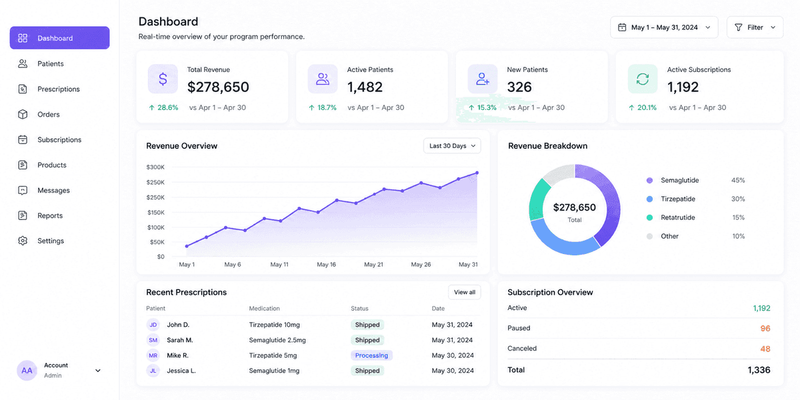
The supplement and telehealth revenues were tracked separately. This allowed the founder to evaluate the clinical channel's unit economics without blending them into the supplement business metrics
Separate Channel Architecture — Telehealth operated as a distinct revenue line with its own unit economics, separate from supplement revenue.
Cross-Sell Revenue from Existing Audience — Supplement customers who converted to the telehealth program had zero acquisition cost, immediately improving the clinical channel's margin per patient.
Peptide Program Pipeline — A second clinical program category was staged before the first was live, reducing future launch time to a configuration step.
Blended LTV Increase — Customers who participated in both the supplement store and the clinical program had a higher blended LTV than those in either channel alone.
Build Your Telehealth Platform Faster
Launching digital healthcare services requires complex infrastructure. Fuse provides the tools needed to connect patients, providers, and pharmacies in one platform.
Retention Systems That Increased Patient Lifetime Value
Recurring Retention Infrastructure — Automated follow ups, refill reminders, and continuity workflows increased repeat patient engagement while reducing operational management overhead.
What Launched
The supplement brand added a clinical revenue channel that ran independently without pulling founder attention away from the core business. The telehealth channel launched within five weeks without disrupting the supplement business.
Core Insights
The supplement brand added a clinical revenue channel that ran independently without pulling founder attention from the core business. Within 90 days the clinical channel was generating monthly recurring revenue that exceeded any single supplement product's monthly performance.
The cross-sell conversion rate from the existing audience was high enough that the first clinical program cohort was profitable without any paid acquisition spend
References
McKinsey & Company Consumer Health Survey (2024) · Hims & Hers Health SEC Filings (2024) · HHS Telehealth.gov · Wheel Virtual Care Report (2024)

Daniel is a two-time founder who has scaled service businesses across major U.S. markets. A Y Combinator competition winner, he focuses on removing operational and regulatory barriers so operators can build and scale modern healthcare businesses.
- Background
- Startup Operations & Service Systems
- Experience
- 2x Founder, Multi-Market U.S. Scaling
- Qualifications
- Healthtech Market Expertise & Operational Scaling
- Key Achievement
- Scaled Premier Staff & Eventstaff across major U.S. markets