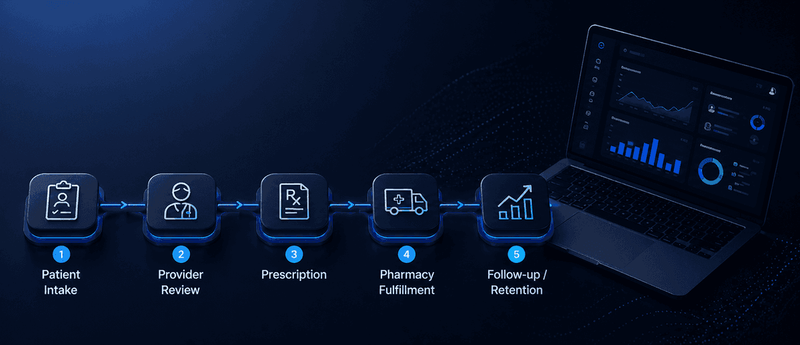

Choosing a white label pharmacy comes down to four proof points: licensed state coverage, structured compliance, stable payments, and performance at volume. FuseHealth packages all four behind your storefront, so you sell programs while clinical review and fulfillment run quietly in the background.
Why the Storefront-First Model Wins
A white label pharmacy partner decides more about your launch than your branding, your ad spend, or even your pricing. Pick well, and your storefront sells wellness programs while licensed providers review intakes and medications ship on time behind the scenes. Pick poorly, and you inherit refund queues, frozen payouts, and customers waiting on orders you cannot see or fix.
This guide walks through the exact checks experienced operators run before signing, the places where most partnerships break, and how a white-label EHR platform ties the whole workflow together so nothing slips through the cracks.
The operators growing fastest right now are not building clinics. They are building storefronts. Your brand owns marketing, checkout, and the customer relationship. Behind the storefront, a structured workflow takes over: a licensed provider reviews each intake, an approved prescription routes to a licensed pharmacy, and the order ships under your brand.
That handoff only works when the pieces are connected. A white-label EHR platform keeps intake, provider review, and order status in one record, so you always know where a customer sits in the process. A white label or low code telehealth solution means you configure a proven system instead of paying developers for a year to build one. The pharmacy is the final link in that chain, and it is the one most operators vet the least.
Five Checks Before You Sign With a White Label Pharmacy
Run every candidate through these five filters. Each one maps to a failure mode that has ended real programs, and each one takes less than a week to verify if you ask the right questions up front. The goal is simple: by the time you sign, there should be nothing left to hope about.
- State licensing that matches your customer map
Ask the white label pharmacy for its license list in writing. A facility licensed in 30 states cannot serve customers in the other 20, and orders from uncovered states get cancelled after checkout, which is a refund and an angry customer every time. If your programs include compounded medications, confirm whether the facility operates as a 503A pharmacy or an FDA-registered 503B outsourcing facility, because the two follow different rules on batch production and patient-specific prescriptions.
- Certification you can verify
LegitScript certification is the credential payment processors and ad platforms check before approving telehealth merchants. A partner that holds it clears your path to running ads and processing cards. A partner that does not will quietly cap your growth before you ever notice why. Verify the certification directly on the LegitScript site rather than taking a logo on a sales deck at face value, and ask whether the certification covers the specific programs you plan to sell.
- Clean integration with your white-label EHR platform
Fulfillment should start automatically the moment a provider approves a prescription inside your white-label EHR platform. If the pharmacy needs faxes, emails, or manual order entry, every step adds delay and error. Ask to watch a live order travel from intake to a shipped tracking number before you commit.
- Payment flow that will not freeze
Telehealth is treated as a high-risk merchant category, and processors watch refund rates closely. A pharmacy that ships late drives refunds, and rising refunds freeze payouts. Confirm average ship times in writing, and ask how the partner handles authorization and capture timing on subscription orders.
- Proof at volume
Anyone can fill 50 orders a month. Ask what happens at 5,000. Get turnaround commitments in writing, and ask for references from operators already running at the volume you are targeting next year, not the volume you have today.
What Fails, and What Works
The pattern across failed programs is remarkably consistent. Operators stitch together a separate intake form, a freelance provider network, an unvetted pharmacy, and a generic payment account. It holds at low volume. Then one weak link snaps: the pharmacy backlogs, refunds spike, the processor freezes funds, and the program stalls for weeks while customers churn.
The programs that scale do the opposite. They run on one connected system where the storefront, white-label EHR platform, provider review, pharmacy routing, and payments were designed to work together. When something needs attention, the operator sees it in one dashboard instead of chasing three vendors by email. That is the difference between a white label or low code telehealth solution built as real infrastructure and a pile of tools held together by hope.
Where Compliance Fits
Compliance should be structured into the workflow, not improvised around it. In practice, that means HIPAA-covered data handling with signed business associate agreements, licensed provider review on every order with no exceptions, and pharmacy routing that respects state-by-state rules automatically, with everything documented inside your white-label EHR platform. When the system enforces these steps by default, you are not relying on memory or manual checks, and an audit becomes a records request instead of a crisis. This is also where a white-label EHR platform earns its keep quietly: every intake, approval, and shipment is timestamped in one place, which is exactly the trail regulators and payment processors expect to see.
Why Operators Choose Fuse Health
FuseHealth was built around one idea: operators should sell programs, not assemble infrastructure. The platform connects your branded storefront and white-label EHR platform to licensed provider review, vetted white label pharmacy partners, and payment rails configured for telehealth from day one. Intake, prescriptions, fulfillment, and payouts live in one system, so the workflow described above is the workflow you actually get. Operators launch in weeks because there is nothing to stitch together, and they scale without rebuilds because the same system runs at 50 orders or 50,000. The pharmacy partners inside the network are already licensed, certified, and integrated, which means the five checks above have been done before you arrive.
Conclusion
The Right Partner Is a System, Not a Vendor
A white label pharmacy is not a line item on your vendor list. It is the part of your business customers feel most directly, because it decides whether their order arrives. Choose a partner with verifiable licensing, certification you can check, EHR integration, stable payments, and proven volume, and every other layer of your program gets easier. Choose on price alone, and every other layer pays for it.
If you want the entire stack already connected, from storefront to EHR to pharmacy to payouts, Fuse Health is the fastest compliant path from idea to first shipped order. Book a walkthrough and see your launch timeline in real numbers.
References
1. U.S. Food and Drug Administration, Human Drug Compounding (503A and 503B)
2. LegitScript Certification for Telehealth and Pharmacy Merchants
3. U.S. Department of Health and Human Services, HIPAA for Professionals

Daniel is a two-time founder who has scaled service businesses across major U.S. markets. A Y Combinator competition winner, he focuses on removing operational and regulatory barriers so operators can build and scale modern healthcare businesses.
- Background
- Startup Operations & Service Systems
- Experience
- 2x Founder, Multi-Market U.S. Scaling
- Qualifications
- Healthtech Market Expertise & Operational Scaling
- Key Achievement
- Scaled Premier Staff & Eventstaff across major U.S. markets