Healthcare automation is the operational backbone that separates scalable telehealth businesses from ones that stall at 200 patients. The platforms enabling automation at every stage of the patient journey — from intake to refill — compress the cost structure that once made telehealth unprofitable at small volumes. Understanding what can and cannot be automated is the foundation for building a program that scales without proportional operational headcount. ⚠ Disclaimer: This article is for informational purposes only. It does not constitute medical or legal advice. Consult qualified professionals before launching any telehealth program or automated clinical workflow.
What Healthcare Automation Actually Covers
Healthcare automation in the context of telehealth covers the administrative, logistical, and communication functions that surround clinical care — not the clinical decisions themselves. The distinction matters both operationally and legally.
What can be automated:
- Patient intake data collection, form routing, and eligibility pre-screening
- Case assignment and routing to the appropriate provider queue based on state, program type, and provider availability
- Prescription transmission to pharmacy partners upon provider approval
- Patient notification at each fulfillment stage — prescription received, shipment initiated, delivered
- Refill triggers based on subscription cycle logic and defined clinical protocols
- Subscription billing, renewal processing, and failed payment retry sequences
- Patient re-engagement communications for adherence and program continuation
What cannot be automated:
- Clinical evaluation of patient intake data
- Prescribing decisions — a licensed provider must review and authorize every prescription
- Clinical judgment on contraindications, drug interactions, or patient-specific risk factors
- Any communication that constitutes clinical advice
Platforms that blur this line — automating elements of the clinical decision process — create compliance exposure. Platforms that automate everything except the clinical layer produce the efficiency gains without the regulatory risk.
The Three Stages Where Automation Has the Highest Impact
Not all automation produces equal operational impact. Three stages of the telehealth patient journey show the largest return on automation investment.
Patient Intake Processing. Manual intake creates inconsistency at volume: incomplete forms, inconsistent eligibility screening, and variable data quality that slows provider review. Automated intake with branching logic routing patients through condition-specific questions, flagging disqualifying responses, and pre-screening for eligibility before a provider touches the case reduces provider review time per case and improves data quality. For programs receiving hundreds of daily intake submissions, the productivity difference between automated and manual intake processing is substantial.
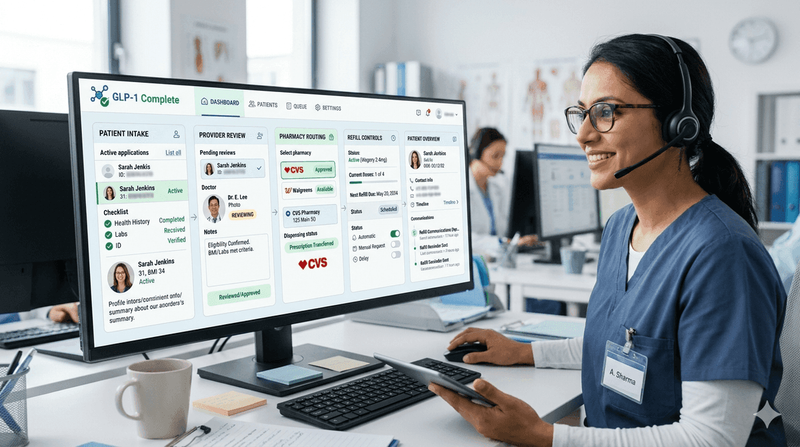
Pharmacy Fulfillment Coordination. This is the highest-impact automation for patient retention. The gap between a signed prescription and a shipped treatment is where subscription businesses lose patients who never intended to cancel. Automated prescription routing eliminates the manual step of exporting a prescription, contacting the pharmacy, and tracking fulfillment status. Patients receive automated notifications at each stage. Operators receive visibility into fulfillment status without requiring staff to chase pharmacy updates. The direct connection between fulfillment reliability and subscription retention makes this the automation investment with the clearest retention ROI.[2]
Subscription Renewal and Refill Management. Involuntary churn patients who would have stayed but dropped because a refill wasn't initiated or a payment failed is almost entirely preventable with proper automation. Automated refill triggers, pre-authorization workflows, and payment retry logic keep patients in program without requiring any manual intervention at the operator level.
What Cannot Be Automated and Why That Matters
The boundary between what can and cannot be automated in telehealth is a compliance line, not just an operational preference.
Licensed providers must review patient intake data and make independent clinical judgments before any prescription is issued. This requirement cannot be automated away, and platforms that claim otherwise are describing a compliance risk, not a feature.
What this means practically for operators: the clinical review step will always carry a cost either as a platform-embedded fee per case reviewed, or as a direct provider cost in a clinic-build model. Automation compresses every other cost in the stack. The clinical review cost is fixed by necessity.
Understanding this boundary also helps operators evaluate platform claims accurately. A platform claiming "fully automated prescribing" is making a claim that should raise compliance questions. A platform claiming "automated everything except the licensed provider review" is describing the correct architecture for a compliant program.
For operators designing their program economics, the clinical review cost per case should be modeled as a fixed variable cost typically $5–$25 per patient case depending on program type and provider arrangement with automation reducing all surrounding costs below and above that clinical layer.
How Automation Affects Unit Economics
The unit economics argument for healthcare automation is straightforward: automation converts fixed headcount costs into variable platform costs, and variable costs scale with revenue rather than against it.
An operator managing 1,000 active subscription patients manually requires a dedicated operations team handling intake follow-up, pharmacy coordination, billing exceptions, patient communications, and refill management. That team is a fixed cost that burns whether patient volume is at 800 or 1,200.
The same operator on an automated platform runs the same 1,000 patients with a fraction of the operations headcount, because every routine function intake routing, prescription transmission, fulfillment tracking, refill triggering, subscription billing runs without human intervention.
The ROI of automation compounds as patient volume grows. At 200 patients, manual operations are manageable. At 1,000 patients, they become the primary constraint on profitability. At 5,000 patients, they become the primary operational failure point. Operators who build on automated infrastructure from day one scale through each volume threshold without rebuilding their operations layer mid-growth.
Healthcare Automation in FUSE Health
FUSE Health is designed around the premise that every operational function surrounding clinical care should run automatically so operators focus on brand, acquisition, and growth rather than on managing workflows.
The FUSE platform automates intake processing and case routing, prescription transmission to pharmacy partners, patient notifications at each fulfillment stage, subscription billing and renewal logic, refill triggers based on configurable program parameters, and patient communications for adherence and re-engagement.
The clinical review step provider evaluation of each patient case is handled by the FUSE licensed provider network, not automated. This is the correct architecture for a compliant program.
For operators evaluating platforms, the right question is not "how much do you automate?" It is "what specifically is automated, what is handled by licensed providers, and where is the operator's responsibility boundary?" A platform that answers all three clearly is describing a compliant and scalable operational model.
Conclusion
Healthcare automation determines whether a telehealth program scales to profitability or stalls under its own operational weight. The programs that compound revenue without compounding headcount are the ones built on platforms that automate intake, fulfillment, billing, and renewal while maintaining proper clinical governance over the prescribing layer.
FUSE Health provides the complete automation infrastructure for non-clinical operators building subscription wellness programs. The operational layer runs automatically. The clinical layer is handled by licensed providers. The operator's focus stays on brand and acquisition.
References
[1] HHS Telehealth.HHS.gov, "Telehealth Policy and Guidance," 2025. telehealth.hhs.gov
[2] American Telemedicine Association, "Operational Best Practices in Telehealth," 2025. americantelemed.org
[3] McKinsey & Company, "Healthcare Automation: Scaling the Clinical and Administrative Layer," Consumer Health Survey, 2024.

Daniel is a two-time founder who has scaled service businesses across major U.S. markets. A Y Combinator competition winner, he focuses on removing operational and regulatory barriers so operators can build and scale modern healthcare businesses.
- Background
- Startup Operations & Service Systems
- Experience
- 2x Founder, Multi-Market U.S. Scaling
- Qualifications
- Healthtech Market Expertise & Operational Scaling
- Key Achievement
- Scaled Premier Staff & Eventstaff across major U.S. markets